THE BACKGROUND : WHERE WE CAME FROM
Turn your face to the sun, and the shadows will fall behind you. Maori proverb.
2019 till now:
We are moving out of the DRC while establishing a liaison office in Europe.
2014 - 2018
We opened MLM in Kinshasa as a platform for administratation.
2013: LAUNCHING THE PLAN IN KINSHASA.
In July 2013 we proposed a conference with three parishes of the diocese of Kinshasa. Our intention was to explain and answer questions about our project.
We approached respectively the following parishes: Saint Augustine in the county of Lemba, Saint Alphonse in Matete and Saint Eloi in Barumbu.
• But between 3-4 pm when we visited, the Pastors of the named parishes were taking their siesta with a strict ban not to wake them up unless it was an emergency...
• It was at our county parish, Saint Augustine located in the district of Lemba, that we were insulted.
• At the second attempt the pastor of St Eloi Church granted us about half an hour in his office, during which he was checking his cell phone and his watch. Eventually he accepted our plan to make a presentation between 3-5 pm in the parish community room on September 5.
• He referred us to the elders (Bayangeli), who lead different teams of the parish, with the aim of clarifying our plan.
• After an hour of discussion with the Bayangeli – with the support of the Pastor – they proposed that we should make a conference on September 5, 2013 from 3-5pm in the parish community auditorium.
To our great surprise, on September 5, 2013 at 2 pm, the Pastor of Saint Eloi in Kinshasa just did the opposite...
Only a few minutes before our conference was due to begin, which was designed to seal our plan to launch the forthcoming Christian Cooperative Bank for Development, the Pastor of Saint Eloi in Kinshasa denied us access to the facilities.
He required immediately a cash deposit of $200 (two hundred dollars) (The minimum monthly salary for a college graduate is $100). He was adamant and arrogant and distant because we did not have that money with us. We found this highly improper and unethical. The Pastor refused to listen to us.
• We kept a low profile and it reinforced our resolve.
We took Susan Walsh’s advice: "In the confrontation between the stream and the rock, the stream always wins, not through strength but by perseverance."
• A few minutes after our misfortune, a Swiss lady, Director of the Guesthouse of the Missionary Oblates of Mary Immaculate in Kinshasa helped us.
• She granted us FREE OF ANY CHARGE the facility of the guest house, i.e. the dining room, much better and friendly by comparison with the Parish Community Room of the Pastor.
• At the end of the presentation, the 42 participants raised funds.
Due to the cooperative procedural reasons per se, we cannot (yet) communicate the amount collected.
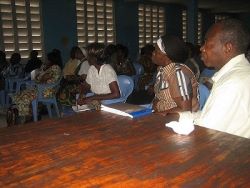
Picture 1: Group discussion after our presentation at St Eloi Parish in Kinshasa.
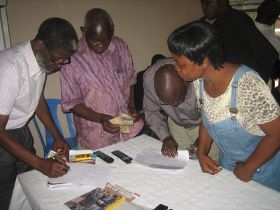
Picture 2: As a result of the conference of Sep.5, 2013 at the Guest House of the Oblats Missionnaries (St Eloi) in Kinshasa.
We started our operations with these client-members.
“Torrents and oceans are made of small drops of water... »
2011-2012: Field survey in the Congo.
After a conference held in Brussels in February 2011 on development issues, Prof.Rev. Pastor Christoph Stueckelberger approached us.
1st meeting with Prof. C. Stueckelberger.
As he is also a member of the board of Directors at Ecumenical Council of Churches (OCC) in Geneva, and he deals with churches in the Congo, he suggested that we must partner with the l’Eglise du Christ au Congo (ECC), member of the OCC, and the second largest Christian community in the Congo.
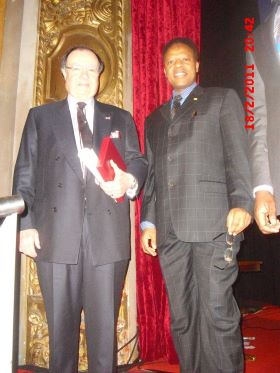
In Brussels with M. George Forrest, a business man established in Congo.
• April 2011:
Christoph paid our ticket and related expenses, we travelled together to Kinshasa, and he introduced us to the ECC authorities.
• He paid for three other trips and stays in Kinshasa for pursuing this initiative...
He also paid for the trip of a lady member of our team in Kinshasa to make a presentation at the International Conference Center in Geneva. The topic was, “Entrepreneur women in a Difficult Environment. »
• At the end of the day we’d say: "the Christian Cooperative Bank for Development” was launched by a Swiss Pastor." (Bernard Nyembo.)
• In Kinshasa we built a team and we proposed to the ECC a business plan for the next three years of activities, as well as a feasibility study. Unfortunately internal problems within the hierarchy of this church jeopardized and froze our proposal.
• We immediately approached the Catholic Church, the largest community in the Congo. We met the head of the Catholics in Lindonge Center in Kinshasa. He appreciated our initiative and he referred us to the National Episcopal Conference of Congo (la Conférence Episcopale Nationale du Congo; i.e. the Cenco).
• But this institution did not respond to our mails, neither to our text messages and telephone calls.
• A few months after our successful attempt to approach the Cenco, we learned in the media that this institution is launching its own bank, with the support of a foreign international cellular phone provider, operating in the Congo.
2006-2010: The extreme right wing in the country came to power..
• Because of exclusion and xenophobia (fortunately it is decreasing since), our initiative was fiercely opposed
• We were victims of daily threats because we wanted to implant “an African Bank” in Geneva...
However, this only forced us to persist. We improved the projects and we decided to move it to Kinshasa, DRC, and open subsidiaries in Geneva and in New York...
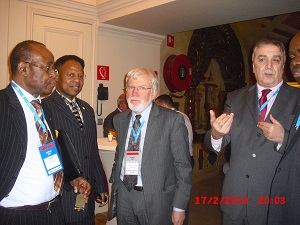
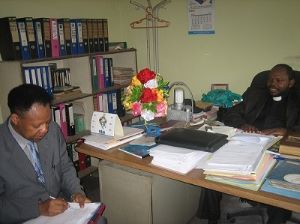
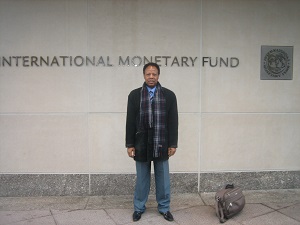
Photo 1: 1st meeting with Prof. C. Stueckelberger in Brussels in Feb. 2011.
Photo 2: Meeting with Rev.Pastor Milenge in his office at ECC.
2005: We launched the feasibility study of the plan: "International Bank for Agriculture, Mining and Industry" (IBAMI) in Geneva.
The opportunity to promote ethical investments in the peripheries of key sectors where a large portion of the population works (formal and informal) in Africa and in Less Developed Countries (LDC’s), but who lack financial support.
• Meeting with investors in San Francisco, Los Angeles, Newport Beach (South of Orange County, California), and with bank authorities in Paris, in Sandtown, in Pretoria, and in Johannesburg.
• We anticipated a special entity of our Bank, oriented to facilitating credit, loans and other commercial instruments, especially to business women, artisans, and farmers.
• The plan was frozen because we found out that some shareholders had improper records and it was unclear about the origin of their funds.
2004:
Business Plan and structuring the background documents.
• Conducted a field survey about banking in Switzerland.
• Meetings with the Commercial Section of the Embassy of France and workshop with the Embassy of South Africa in Bern, Switzerland.
• Workshops in Geneva with one of the «Big 4 » for the audit and assessment of our project. Experts were amazed at our preparedness and how we mastered the topic. They supported us and encouraged us to keep going.
• We wrote the Business Plan for three years, including: the administrative section, Information Technology, Accounting Procedures, the Global Strategy, Risk Management, and the Forecast, etc.
1995-2003:
Identification of the opportunity...
We are stunned why there is no African bank operating in the major financial places of the world.
We also wonder how to raise funds for adding value in the sectors of agriculture, fishing, and farming, as well as energy, mining and infrastructure, to leverage economic and social progress in the DRC.
• The core element was the identification of enormous potential in the banking industry in the DRC
• In March 1999, we had the idea to launch an African Bank based in Geneva.
